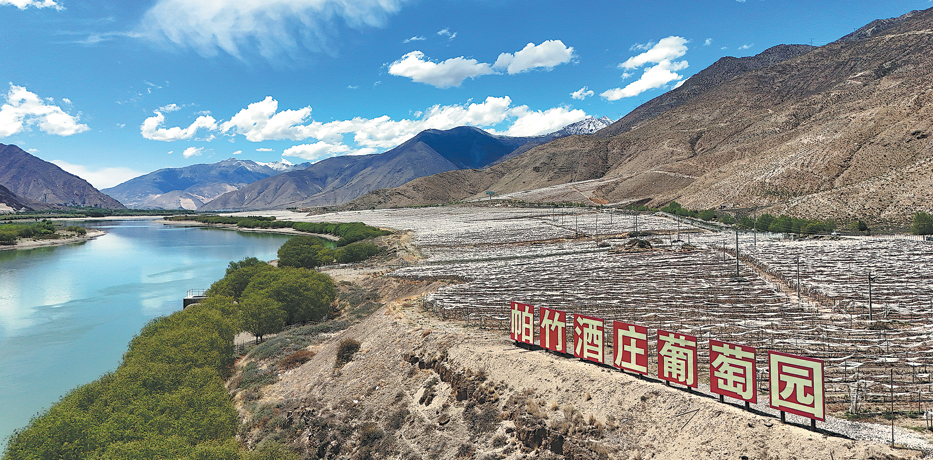
Pazhu Vineyard spreads along the Yarlung Zangbo River in Sangri county, Xizang autonomous region. CHINA DAILY
In autumn, rows of grapevines stretch as far as the eye can see across the Yarlung Zangbo River valley in the Xizang autonomous region, a striking scene against the plateau landscape.
This picturesque scenery can be seen at the Tharmo village in Sangri county, Lhokha city, where land once considered difficult to cultivate has been turned into a thriving grape-growing area.
The transformation began in 2011, when a 1-hectare trial plot was established in Tharmo to test whether grapes could grow in a high-altitude environment.
Today, vineyards across Tharmo and surrounding villages in Sangri cover about 667 hectares.
However, the journey has not been without challenges.
At that time, the area, located at an altitude of around 3,600 meters, was considered too harsh an environment for grape cultivation, with strong winds, sandy and saline-alkali soil, frost and hail posing major challenges to cultivation efforts.
"The biggest challenge was the high altitude, because no one had tried growing grapes at this elevation before," said Li Xiaoping, deputy general manager of Pazhu Vineyard, a major company involved in the Sangri grape industry.
Over the years, the company worked with research institutions to develop cultivation methods adapted to the plateau environment, including soil improvement, irrigation systems and ecological restoration measures. The process progressed from initial experiments to pilot-scale trials, and eventually large-scale planting.
The efforts gradually paid off. "After eight years of testing more than 60 varieties, we selected six that were suitable for the high-altitude environment of the Qinghai-Tibet Plateau and the Yarlung Zangbo River valley," Li said. The region's strong ultraviolet radiation, dry climate and significant day-night temperature differences are believed to contribute to distinct grape characteristics.

Grapes cultivated at Pazhu Vineyard are more tolerant to the cold plateau environment. CHINA DAILY
One selected variety is Yajiang No 1, a grape variety specifically developed for the plateau environment. With red skin, red flesh and a red core, it is more tolerant to the cold plateau environment and is mainly used to produce dry reds and some sweet wines, he said.
Studies by the Institute of Botany of the Chinese Academy of Sciences found that anthocyanin levels in the grapes could be six to 12 times higher than those in grapes from plain regions, according to Science and Technology Daily.
The highland grapes were later processed into wine products. Pazhu Vineyard began commercial wine production in 2021 and now produces 10 varieties of wine.
In 2025, the winery produced about 500,000 bottles, with output continuing to increase. Its products are sold to several domestic markets and exported to Hong Kong, while the company continues to explore overseas markets, Li said.
Beyond wine production, the grape industry also brought job opportunities to local residents who can earn income without leaving their communities.
Sonam Penpa, a local employee at Pazhu Vineyard, previously worked in construction far from his hometown. "Before the vineyard was built, we had to leave home to find work elsewhere," he said. "After the vineyard was established, we could work close to home all year round and have a stable income."
He joined the company six years ago and has since become an experienced worker.
After learning grape cultivation and winemaking, he began training other workers in grape growing, selection, and sorting.
Between 2017 and 2025, with support from local authorities, the grape-growing base provided long-term employment for about 80 local residents, while about 3,000 people from surrounding villages took turns working in the industry.
During that period, Pazhu Vineyard paid 59.3 million yuan ($8.9 million) in wages, Li said.
Today, the grape-growing area is also developing into a highland wine tourism destination. Visitors can pick grapes, taste highland wines and explore the river valley landscape.
By integrating grape growing, winemaking and tourism, the area has developed into a modern agricultural estate, connecting technology, industry and local livelihoods on the plateau.
guoyanqi@chinadaily.com.cn