This year marks the 90th anniversary of the Long March, an epic and perilous journey critical to the founding of the People's Republic of China. Back then, the Red Army faced harsh conditions while crossing the grasslands in southwest China. Today, these grasslands remain part of local life, sustaining a rich variety of herbs used in Tibetan medicine. Yang Jinghao has the story.
These two specimens of a plant known as huanghuacao, or yellow-flowered grass, are preserved at the National Museum of China. A Red Army soldier collected them in 1936 while crossing the grasslands in Ruoergai during the Long March. He kept them for decades, leaving behind a rare physical record of that difficult journey.
YANG JINGHAO Ruoergai County, Sichuan Province "Ninety years ago, the Red Army crossed this grassland with little food and limited medical supplies. Some accounts say that soldiers turned to wild plants when they were short of food."
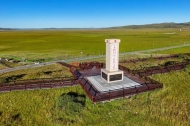
This sculpture in Ruoergai offers a glimpse of the hardships. It commemorates the Red Army soldiers who lost their lives in the grasslands, where bitter cold, hunger and illness took a heavy toll.
ZHANG JIANRONG Long March History Educator, Ruoergai County "Standing here today, we remember those who gave their lives, and we mourn their loss. But it was through their sacrifice that the revolution ultimately triumphed. These fallen heroes, both named and unnamed, are the backbone of the People's Republic of China."
Ruoergai was also the site of the Baxi Meeting in September 1935, when the Red Army reaffirmed its decision to continue north, a crucial moment in the Long March. Life here has changed dramatically over the decades. Yet wild plants continue to grow across the grasslands, and some are still used in traditional Tibetan medicine to serve local community. Tibetan medicine is regarded as one of the world's four major traditional medical systems, with a history spanning more than 3,800 years. According to the Ruoergai County Tibetan Medicine Hospital, more than 700 species of wild plants in the area can be used for medicinal purposes.
NANCUOJI Medicinal Research Department Ruoergai County Tibetan Medicine Hospital "The season of collection, the part of the plant used, and the processing method all matter. If a medicinal herb is not processed properly, it can even become toxic."
Today, traditional Tibetan medicine is also embracing modern production methods. Pills that were once made by hand can now be produced using machines.
NANCUOJI Medicinal Research Department Ruoergai County Tibetan Medicine Hospital "With pill-making machines, we can increase production and ensure that the pills are more uniform in size."
But traditional practices remain an important part of Tibetan medicine. One example is its heated-metal therapy, mainly used to treat joint conditions and certain internal disorders.
TASHI TSERING Doctor, Ruoergai County Tibetan Medicine Hospital "We may treat around 10,000 patients a year, applying it at 50,000 to 60,000 acupuncture points. Many people welcome it because they say they feel the effects quickly."
Local practitioners believe Tibetan medicine has a promising future. Ninety years after the Long March, knowledge of the land continues to be passed on, linking Ruoergai's history with the lives of its people today. YJH, CGTN, Ruoergai County, Sichuan Province.