Experts say Beijing-Xizang artery played important role in spreading Buddhism, laying foundations for greater unity
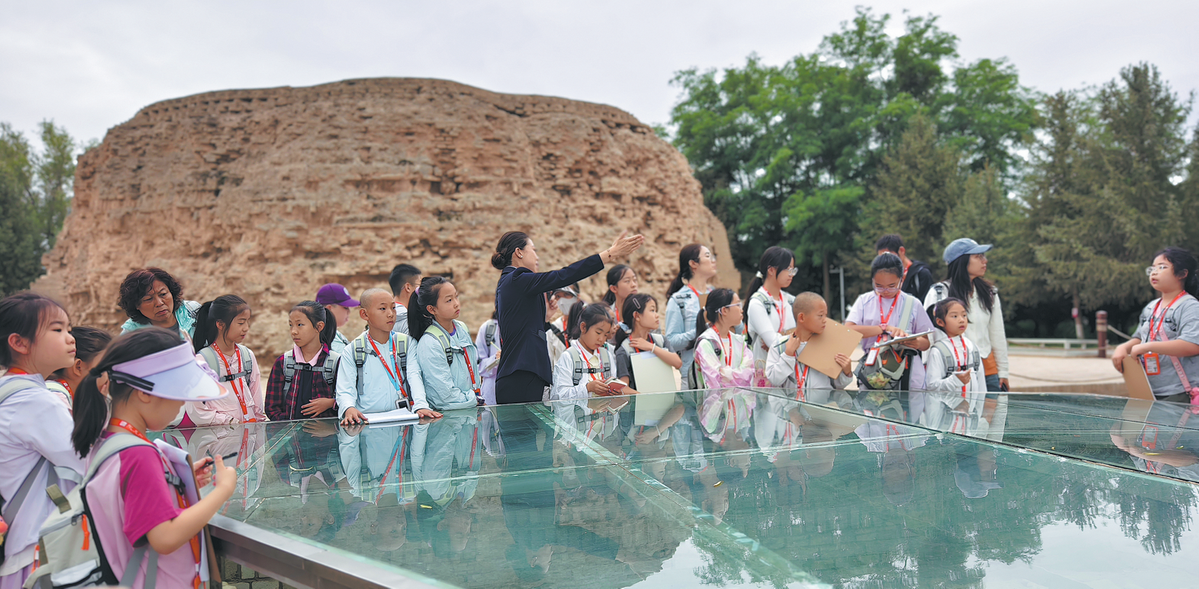
Standing in front of Sakya Pandita's relic stupa that contains his remains and precious items of the Liangzhou Talks, primary school students learn about its history at the Liangzhou Meeting Memorial Museum in Wuwei, Gansu province. CHINA DAILY
For three years Garwa Nyakwang Zangbo — an abbot at a Buddhist monastery in Xining, Qinghai province — traveled more than 25,000 kilometers for a passion project he hopes will end in wider recognition of a lesser-known but historically important ancient route of China.
The Beijing-Xizang Ancient Road served as a political, cultural and religious bridge during the Yuan Dynasty (1271-1368).
Significantly, in the 13th century its embrace included prominent Buddhist leader Sakya Pandita, who traveled the road from the present-day Xizang autonomous region.
"I'll spend the rest of my life achieving this goal, until I die. It's my mission," said Garwa.
"Thanks to modern transportation, my journey was much easier than that of Sakya Pandita more than 800 years ago," added the 59-year-old.
The ancient route consisted of 82 relay stations, with its main artery stretching for more than 4,000 km across what are now seven provinces and three autonomous regions of China. Serving as transportation hubs, some of the relay stations were monasteries, while others had important monasteries built around them.
Garwa's Hongjue Monastery is one of the major stations that is still active today.
In 2019, the abbot and his team embarked on a journey along the route to trace and document every relay station as part of field research for the National Social Science Fund of China.
"The road serves as a comprehensive record of Xizang's official incorporation into the central administrative system in the Yuan Dynasty, and it should be well preserved," said Garwa. "The integrity of the route is very important. Every relay station is part of our national memory."
The journey has not been easy. Some relay stations have been eroded by the elements and are difficult to locate, while others are hard to reach because of poor transportation conditions.
Yet, it was along this ancient road that Tibetan Buddhism spread and became integrated into Chinese civilization. The route also played a key role in interaction between various ethnic groups, including Tibetans, Hui, Salar and Uygurs.
Its importance is extensively detailed in the book The Beijing — Xizang Ancient Road: A Study of the Ancient Courier Road from Beijing to Xizang in the Yuan Dynasty.
The book is the interim output of the Research on the Belt and Road Initiative and the Development of Tibetan Buddhism, a major project of the National Social Science Fund, which concluded on Sept 5.
The push to have the ancient road recognized for its historical and cultural importance is gathering momentum.
During the 2026 Two Sessions, E Chongrong, a member of the National Committee of the Chinese People's Political Consultative Conference, the country's top political advisory body, proposed that the road be nominated for UNESCO World Heritage status. From the Tu ethnic group in Qinghai, he cited its profound impact on national unification and ethnic integration.
A proposal concerning the protection of the Beijing-Xizang Courier Road and its application for World Heritage status has been officially submitted to the CPPCC National Committee and referred to the National Cultural Heritage Administration, sources told China Daily.
"The road represents an important interchange of human values over a span of centuries. It awaits the right opportunity to be recognized by UNESCO," said Li Decheng, former deputy director of the China Tibetology Research Center, and also one of the leading figures in the research project.
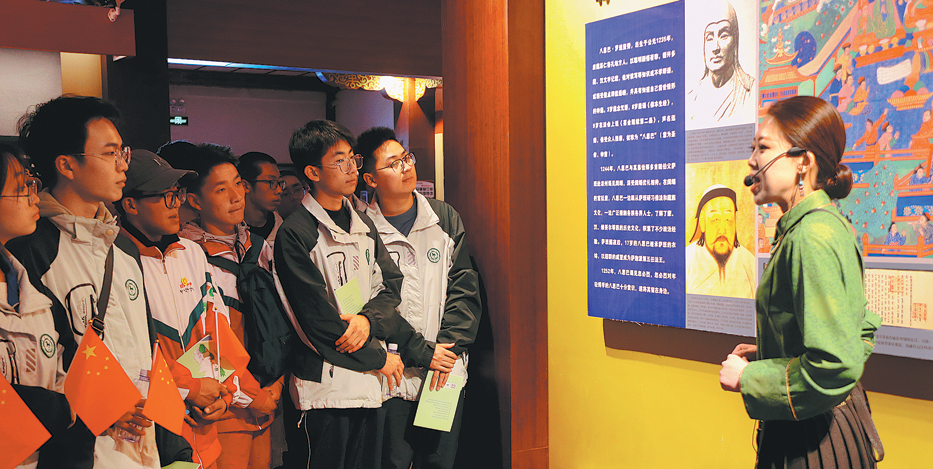
Students from Lhasa Middle School and Wuwei No 1 Middle School participate in a joint study tour at the museum in March 2025. CHINA DAILY
Peaceful talks
The route incorporated major sections of the Tang-Tubo Ancient Road and the Tea Horse Road, while also intersecting with the Southern Silk Road.
Its history can be traced back to the Liangzhou Talks of 1247, when Prince Godan of the Mongol Empire met Sakya Pandita, a revered religious leader of the Sakya school of Tibetan Buddhism.
In 1244, invited by Prince Godan, Sakya Pandita, then 63, embarked on a three-year journey across thousands of kilometers to meet him in Liangzhou, present-day Wuwei in Gansu province.
When he arrived in 1247, the two sides held talks and reached a consensus on the peaceful incorporation of the region into the administration of the Mongol Empire.
The agreement, later formalized in Sakya Pandita's "Letter to the Tibetan People", effectively ended four centuries of internal strife and formally brought the region under the administrative jurisdiction of the central government.
Phagpa, a Tibetan Buddhist leader who later became imperial preceptor of the central government, the first in the Yuan Dynasty, also participated in the talks.
Chen Qingying, a renowned Tibetan scholar and Garwa's teacher, said Phagpa eventually helped promote religious harmony and persuaded the Mongol royal family to tolerate different schools of thought.
"That helped consolidate the historical trend of Buddhism, Taoism, Confucianism and other schools of thought developing together," Chen said.
Sakya Pandita spent the rest of his life in Wuwei, devoting himself to preaching, writing and establishing Sakya monasteries across the Hexi Corridor in western Gansu, until his death in 1251 at the age of 70.
Popular attraction
Since 2019, the Liangzhou Meeting Memorial Museum in Wuwei has welcomed 480,000 visitors representing all 56 ethnic groups across China.
The museum, preserving sacred relics of Sakya Pandita's remains and precious items of the historic event, has become a tourist attraction and begun to play a role in educating teenagers.
Huangfu Yangzi, 34, has worked as a museum guide for six years. When explaining the history of the talks to visitors from different regions and ethnic backgrounds, she said it often resonates more strongly with those from Qinghai and Xizang. "Sakya is highly revered. This history is very much alive. When visitors from these regions see the artifacts on display, they are deeply moved."
From June to July, the museum received 23,500 visitors, primarily families on motoring vacations and students participating in study tours during the school holidays.
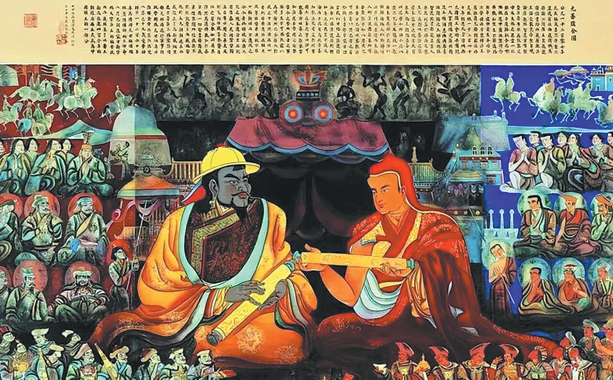
The painting Yuan Bo Rui He Tu (Auspicious Convergence of the Yuan and Tibetan Peoples) depicts the historical scene of Sakya Pandita and Prince Godan exchanging documents during the Liangzhou Talks. CHINA DAILY
Over the past three years, study tours have become the museum's largest source of growth, with more than 26,000 primary and secondary school students visiting.
The museum has also started 12 youth education programs at primary and secondary schools in Wuwei.
After visiting the museum, Tsechu, a first-year senior high school student at Lhasa Middle School in Xizang, said: "For me, the Liangzhou Talks were something I learned about in a textbook. Being able to come here in person, to the very place where the talks took place, has brought what I learned in the textbook to life."
Tsechu said that exchanging ideas with students from Wuwei No 1 Middle School was also inspiring. "We talked with each other and gained a deeper understanding of each other's cultures."
The museum has also welcomed a growing number of visitors from Hong Kong, Macao and Taiwan over the past two years, staff members said.
Li Decheng, 60, a Mongolian and former deputy director of the China Tibetology Research Center, who also played a supportive role in Garwa's research, said the wisdom of the Liangzhou Talks in resolving differences through dialogue and peaceful means still resonates in China's philosophy.
shenwendi@chinadaily.com.cn