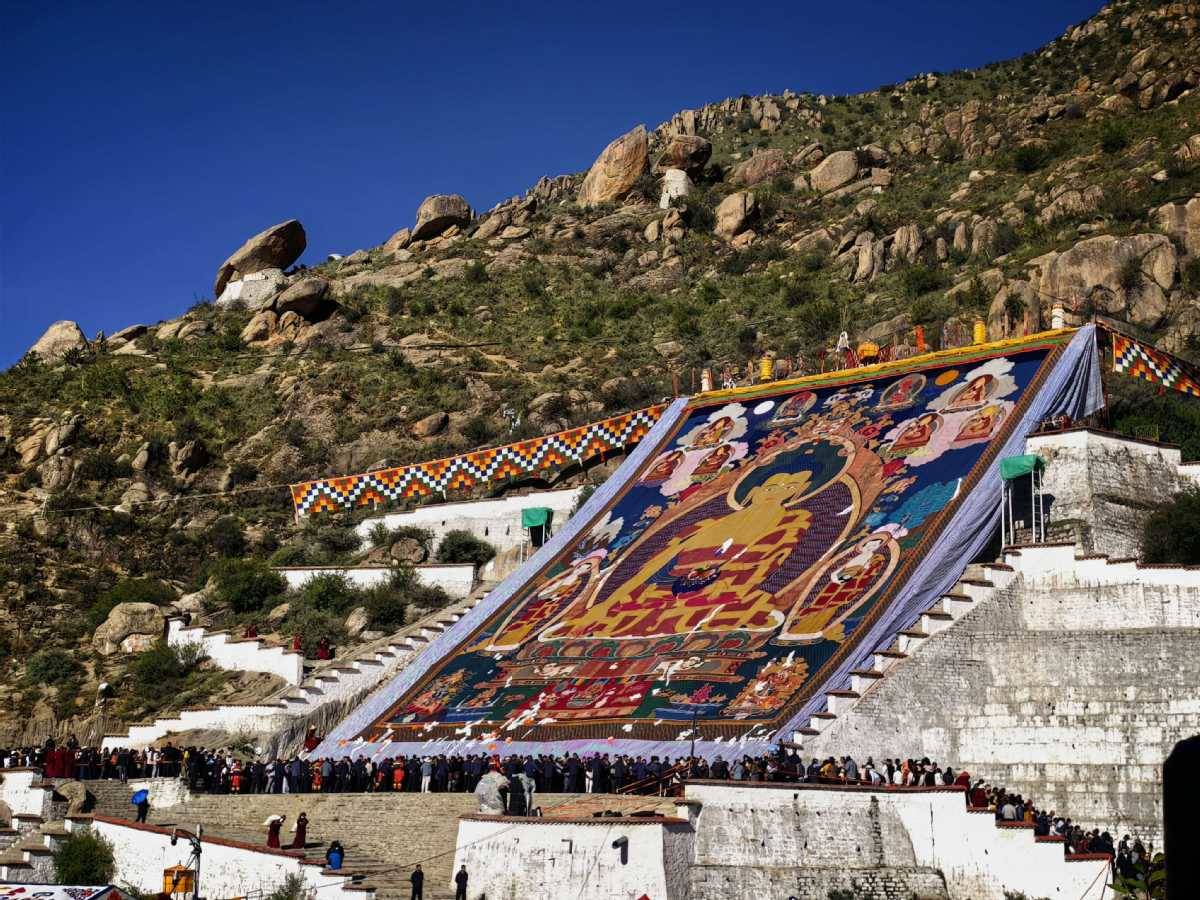
People visit a giant thangka marking the start of the annual Shoton Festival on Wednesday in Lhasa, Xizang autonomous region. [Photo by Palden Nyima/chinadaily.com.cn]
The Shoton Festival, one of the most well-known traditional festivals in the Xizang autonomous region, commenced in Lhasa on Wednesday, attracting tourists from around the globe eager to experience the region's cultural heritage.
The festival's opening ceremony at Lhasa's Drepung Monastery featured the unveiling of a giant thangka embroidery depicting the Buddha.
Shoton, meaning "yogurt banquet" in Tibetan, began as a religious tradition where locals offered yogurt to monks after their summer retreat. Over time, it has evolved into a celebration featuring Tibetan opera, cultural performances, and various festivities.
This year's festival has drawn visitors from Russia, France, Portugal, and other countries, adding an international dimension to the celebration.
Cathy, an Australian visitor who last attended the Shoton Festival 40 years ago, expressed amazement at the region's development, particularly after experiencing the Qinghai-Xizang Railway linking the autonomous region with nearby Qinghai province.
Liu Ke, an artist from Hubei province, participated in the festival's cultural activities at the Norbulingka Park, where she sold her hand-painted thangkas.
Her works were a hit with international visitors, not surprising considering the positive feedback she has received on YouTube. This increasing international interest is also evident in the Tibetan opera performances at the festival.
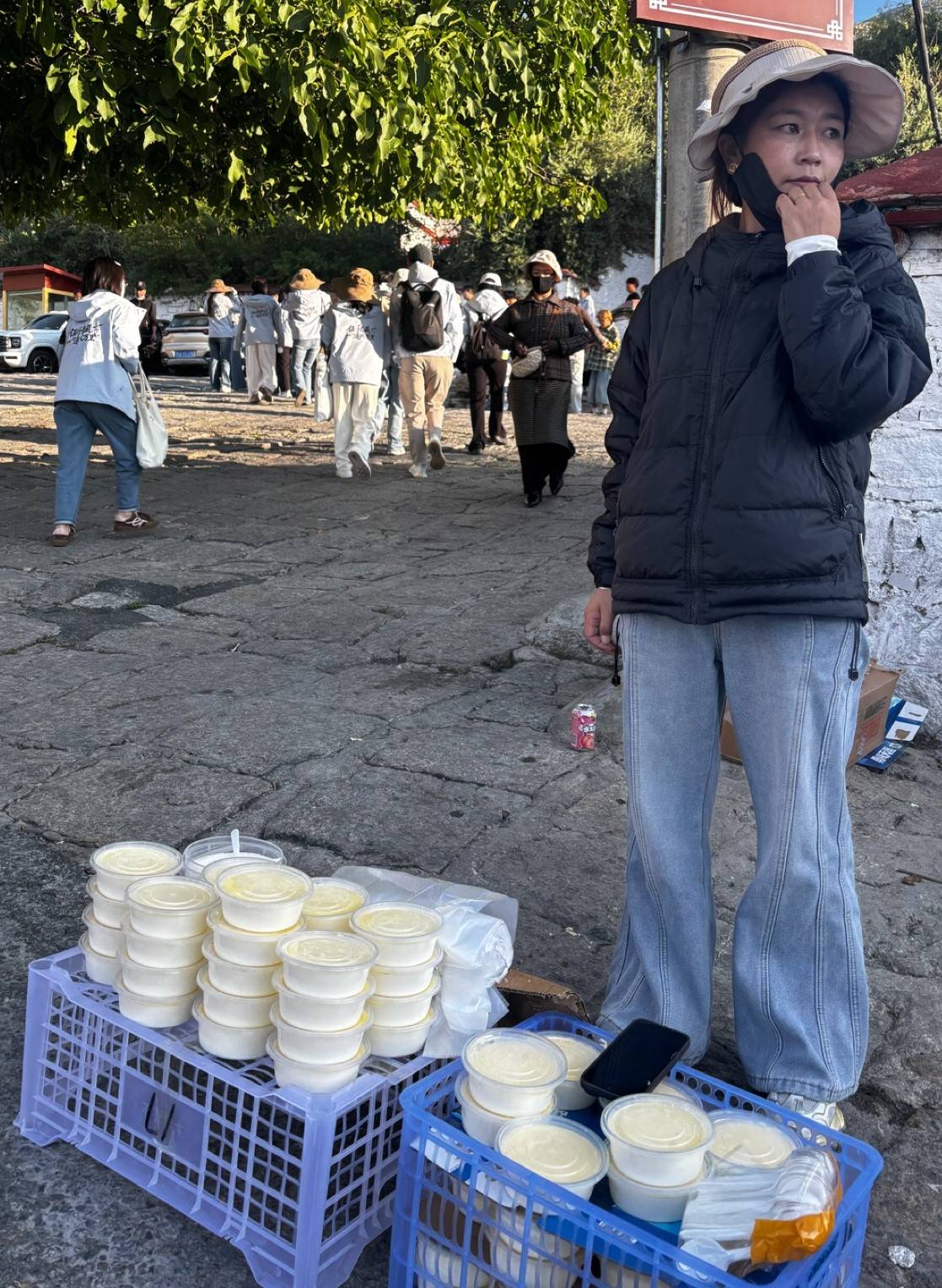
A woman sells yogurt at the Drepung Monastery in Lhasa, capital of the Xizang autonomous region, as the annual Shoton Festival kicks off. [Photo by Palden Nyima/chinadaily.com.cn]
Lhadron, leader of a Tibetan opera troupe and a national-level inheritor of the art form, noted the growing attention from international visitors in recent years. "Seeing audiences from different backgrounds, including foreign visitors, makes me proud, as it offers an opportunity to expose Tibetan culture to a wider audience," she said.
Chen Hongxin and Zheng Siyu contributed to this story.