Filmmaker and author Dai Sijie returns to the Chinese language to explore Tibetan thangka art, Yang Yang reports.
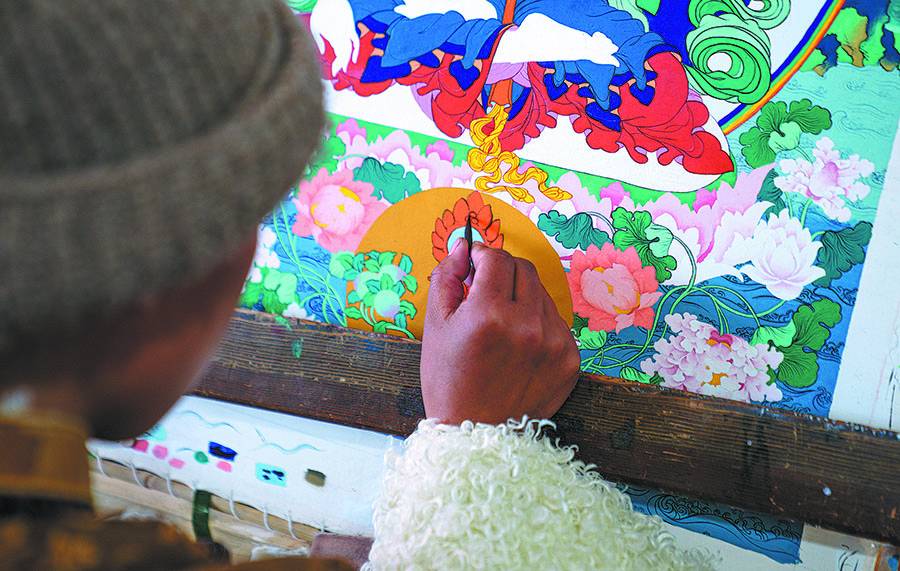
At the Thangka Academy in Lhasa, Xizang autonomous region, a student paints a thangka, which is the theme of writer Dai Sijie's latest novel The Thangka Painter. [PHOTO/XINHUA]
A herdsman living on the Qinghai-Tibet Plateau in Qinghai province falls from a mountain while trying to save a yak. His 12-year-old daughter, Gexiangjiu, sets out to find a doctor and meets Mado, a hearing and speech-impaired boy of the same age who comes from a long line of thangka painters.
Trained by a renowned master, Mado believes his art can save Gexiangjiu's father. Convinced that the man will live as long as he keeps painting, he begins creating a thangka. But an unexpected incident interrupts his work, and the two children's lives take different paths. Mado gives up thangka painting for a decade, while Gexiangjiu, inspired by him, studies art at an academy. Thirteen years later, they meet again.
This is the latest novel The Thangka Painter by writer, screenwriter and film director Dai Sijie, who has lived and worked in France for decades.
The novel began to take shape in 2018 or 2019, when Dai returned to his hometown of Chengdu, Sichuan province, to care for his seriously ill mother. During a quiet moment by her bedside, a sentence came to him almost instinctively: "Aba (father in Tibetan) is dying, firelight flickering on the bandages wrapped around his head."
Before returning to Chengdu, Dai had just completed a French novel featuring an elderly thangka painter.
Thangka refers to traditional Tibetan Buddhist scroll paintings made with natural mineral pigments on fabric. It's popular in areas such as the Xizang autonomous region and Qinghai province. Created according to strict iconographic conventions, they depict Buddhist figures and stories and serve as important objects of worship. Recognized as an intangible cultural heritage, thangka painting embodies the faith, artistic traditions and cultural wisdom of the Tibetan ethnic people.
"Perhaps it's the 'previous-work syndrome' that brought Xizang to mind as I sat by my mother's sickbed," Dai writes in the postscript of the novel.
From that single sentence grew a story about miracles. At its heart is a young thangka painter who believes that as long as he continues painting, the dying father will remain alive.
Dai describes writing the novel as "a spiritual practice". For him, both thangka painting and fiction represent a life force that resists time and pushes back against death.
"I wrote about two young people who paint tirelessly, hoping their art can save those they love. Deep down, it reflected my own longing for a miracle. Sadly, when the book was published in 2022, my mother had already passed away," Dai said at a book event in Beijing in early July.
A return to roots
Speaking about the novel's origins, Dai recalled his lifelong connection with thangka art.
Born in Chengdu in 1954, Dai was sent to the mountainous region of Yingjing county, Ya'an in Sichuan province, during the "cultural revolution" (1966-76). There, among Khampa Tibetan ethnic people, he was introduced to Tibetan culture and the tradition of thangka painting.
After the "cultural revolution", he enrolled in Sichuan University in 1977. Seven years later, he moved to France to study art history, initially intending to write a doctoral dissertation on thangka. His interests eventually shifted to cinema, leading him to France's prestigious state film school, La Femis. After graduating, he settled in France and built a career in filmmaking.
While living there, he frequently visited a museum with a permanent collection of East Asian art, spending countless hours studying its thangka paintings. That deep familiarity with the tradition lends remarkable authenticity to The Thangka Painter. Dai vividly re-creates every stage of the artistic process, from selecting subjects and preparing precious mineral pigments to mastering intricate painting techniques.
Through this sacred art, he explores the inner lives of his characters while reflecting on universal themes of faith, mortality, redemption and family.
Since publishing his debut novel, Balzac and the Little Chinese Seamstress, in 2000, Dai has written eight books.
The semi-autobiographical novel, originally written in French, tells the story of two young intellectuals sent to a remote village during the "cultural revolution", where forbidden Western literature transforms their lives. It became an international best-seller, selling more than 1 million copies in France and over 500,000 English-language copies. Translated into more than 40 languages, a film adaptation gained nominations in 10 international film awards, including the Golden Globes for best foreign language film and the Golden Horse Award for best adapted screenplay.
His later works include Mr Muo's Travelling Couch, which won France's literary prize Prix Femina in 2003, Once on a Moonless Night (2007) and The Gospel According to Yong Sheng (2019), all written in French.
For The Thangka Painter, however, Dai chose to write in Chinese. French, he says, lacks the vocabulary to fully express the cultural richness and artistic nuances of thangka, while Chinese allows him to capture its colors, textures and spiritual meanings with greater precision.
He deliberately adopted a slow, highly descriptive style, sometimes devoting several pages to a single painting, wanting readers to "almost smell the colors", he says.
"Rich, detailed descriptions help immerse readers in my spiritual world. The pacing is designed to support the theme, so the story doesn't rely heavily on dialogue or multiple character interactions. Instead, its strength lies in the intricate and extended portrayal of imagery," he says.
Praise for literary purity
Poet and critic Ouyang Jianghe has praised The Thangka Painter for its literary quality. He argues that the sense of "purity" once found in Chinese literature as a public and historical value has largely faded, yet Dai succeeds in reviving it in the novel.
According to Ouyang, this purity emerges in two ways. It is reflected in the contemplation of sacred images as the subject of painting, and in the creative energy the novelist brings to the work — a force capable of bringing together diverse artistic techniques into a unified whole.
"When Dai describes the creation of a thangka, the narrative slows dramatically, as though time itself has stopped. Rather than relying on the technical language of modern art theory, he writes with spiritual insight," Ouyang says.
"Whereof one cannot speak, thereof one must be silent," Ouyang quotes Austrian philosopher Ludwig Wittgenstein, who believed human language has its limits when talking about deeply abstract things like ethics, the sacred or the meaning of life.
Literature, however, can approach the inexpressible through patient, nuanced description, he argues. Dai demonstrates this in the novel as Mado, though unable to hear or speak, gradually brings an unseen sacred world to life through his brush.
Ouyang also points to the novel's treatment of thangka pigments. Created from rare minerals often more valuable than gold, the pigments are painstakingly ground and applied by hand. The process transcends commercial value, reflecting the spiritual discipline at the heart of thangka painting.
He also believes the relationship between Mado and Gexiangjiu rises above conventional romance, embodying a rare spiritual purity.
Film director Zhang Yang, whose Paths of the Soul is also set on the Tibetan Plateau, praises Dai's deeply researched portrayal of Tibetan religious life, everyday customs and the region's landscapes, saying the novel evokes vivid, cinematic images.
Although grounded in reality, the story also reaches beyond realism. Mado and Gexiangjiu's connections across time and space, together with its depictions of memory and near-death experiences, create a rich poetic imagination that Zhang believes is inherently cinematic.
A film adaptation of The Thangka Painter is now in development, with Mao Dun Literature Prize-winning Tibetan writer A Lai serving as a consultant.