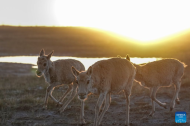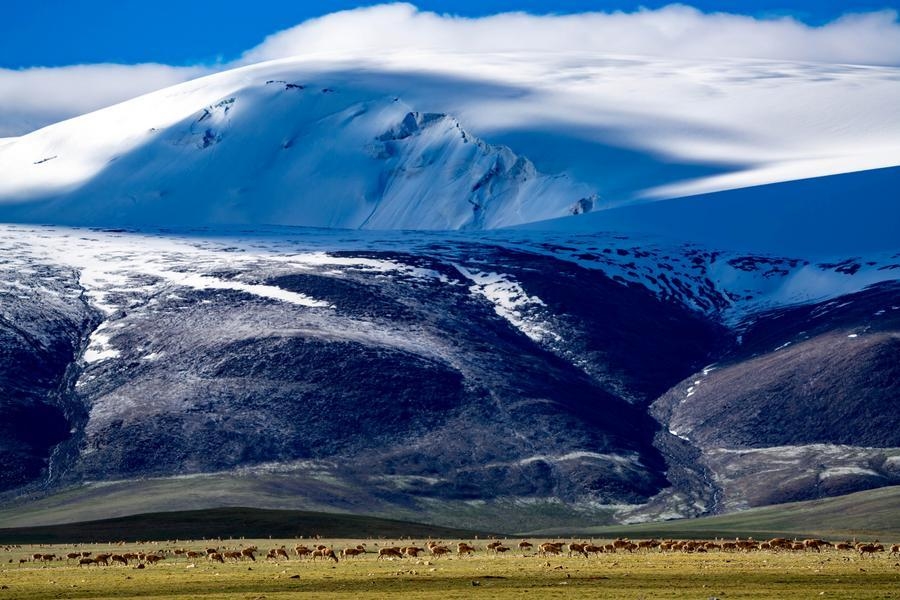
Tibetan antelopes and their calves are seen after crossing the Senlong Zangbo River in Changtang National Nature Reserve in southwest China's Xizang Autonomous Region, July 12, 2026. (Xinhua/Jiang Fan)
by Xinhua writer Lodro Gyatso
LHASA, July 22 (Xinhua) -- The newborn antelope appeared in my viewfinder for only a second before the river rolled it over.
Its head surfaced, disappeared and surfaced again. The current carried it downstream. Its mother looked back as the calf grew smaller in the distance. Around them, thousands of Tibetan antelopes were still entering the water.
Then the wildlife rangers began to run.
"Don't get too close," Ganden shouted into his radio. "Don't startle the herd."
A calf was in danger, but the rescue could not be allowed to panic the animals behind it. On this remote stretch of the plateau, helping wildlife also requires knowing when to keep one's distance.
Several hours earlier, before sunrise, I had followed Ganden into the Changtang wilderness of northern Xizang Autonomous Region. We were more than 5,000 meters above sea level, beside the Senlong Zangbo River, waiting for the annual migration.
The pickup's headlights cut through the darkness. Snow had fallen in the mountains overnight, and wind slipped through gaps in the windows and cut against our faces.
The plateau is high, oxygen-poor and exposed to fierce winds. Yet wildlife was already visible before dawn. Kiangs, or Tibetan wild asses, ran past with their heads and tails raised, while farther away, the dark shapes of wild yaks were scattered across the landscape.
Ganden, a ranger at a local station of the Changtang National Nature Reserve, parked on high ground several kilometers from the river.
"They will come down from that slope after daybreak," he said.
We switched off the lights and waited.
At first, pale shapes began to emerge on the opposite hillside. Then, as the sky brightened, the slope itself seemed to move.
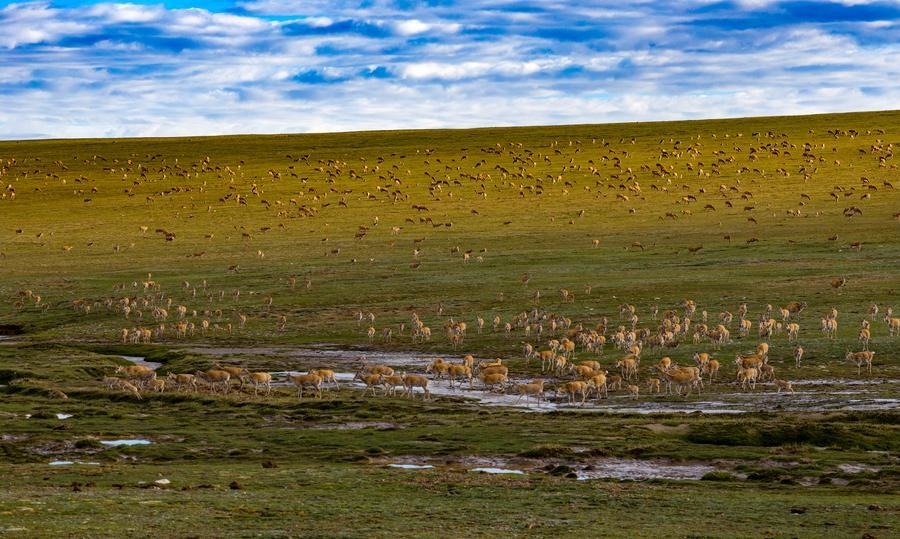
A drone photo shows Tibetan antelopes and their calves crossing the Senlong Zangbo River in Changtang National Nature Reserve in southwest China's Xizang Autonomous Region, July 12, 2026. (Xinhua/Jiang Fan)
Tibetan antelopes streamed over the slopes and grassland in their thousands. Calves stayed close to their mothers, their slender legs moving quickly to keep pace.
The spectacle was immense, yet the herd made little noise. What carried across the plateau was the low roar of the river, cold and fast after the mountain snowfall.
"They used to run far away when they saw a vehicle," Ganden said. "Now, as long as we do not approach or disturb them, they continue on their own way."
By midmorning, the first animals had reached the bank. The mothers entered ahead of their young. The calves followed, leaping into the current. Most crossed quickly, climbed onto the opposite bank and stumbled after their mothers. But one calf lost control and was swept downstream.
Through my camera, I watched its small body being tossed by the current.
Rangers ran downstream along the bank. They knew every bend in the river, every patch of marshland and the shallows where they could find firm footing.
At the edge of a shoal, one ranger waded into the icy water. As the current pushed the calf toward the bank, he reached out and gently lifted it clear.
The calf was soaked, its legs trembling and its nostrils fluttering. The ranger quickly wiped the icy water from its nose and mouth, carried it to a sheltered spot, took off his coat and wrapped it around the calf.
Once the calf had regained some strength, the rangers placed it on a safe patch of grass closer to the herd and slowly backed away. It struggled to its feet, took a few unsteady steps, fell, rose again and ran off.
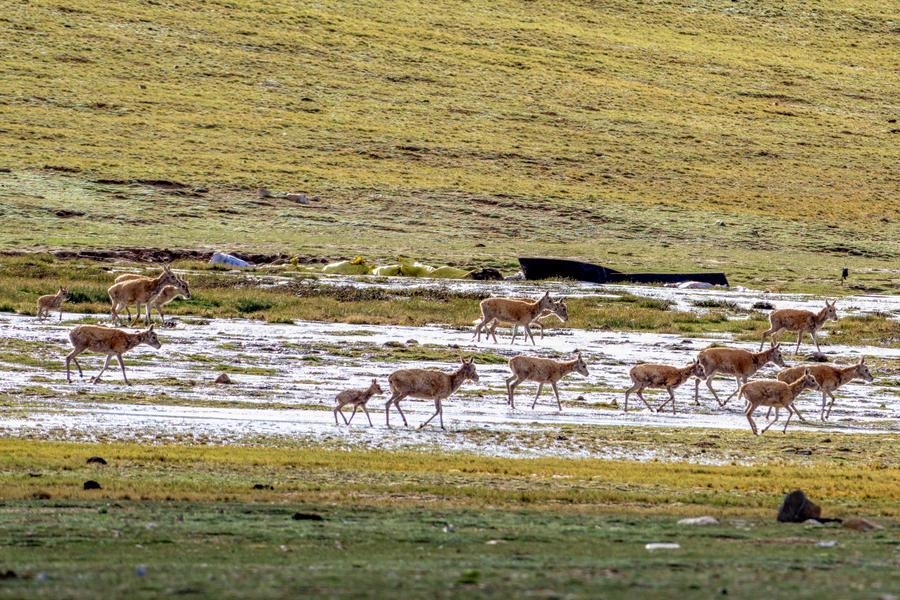
A drone photo shows Tibetan antelopes and their calves crossing the Senlong Zangbo River in Changtang National Nature Reserve in southwest China's Xizang Autonomous Region, July 12, 2026. (Xinhua/Jiang Fan)
No one cheered. The herd continued crossing.
"Crossing the river is a life-or-death test that young Tibetan antelopes have to face," Ganden said. "We provide limited assistance only when we can do so without disrupting their normal behavior."
Then he added, "It is a life. That is reason enough."
Beside the river, wildlife protection took a practical form: keeping a distance, avoiding disturbance, stepping in when a calf was in danger, and withdrawing once the rescue was over.
More local herders are now helping with patrols, rescues, rubbish removal and the clearing of obstacles along migration routes. The rangers said that in early and mid-July, Tibetan antelopes cross the river each morning and evening for more than 10 days, with more than 150,000 making the crossing each year.
By late morning, sunlight covered the grassland. The antelopes had crossed the river and were moving deeper into the plateau. A Tibetan gazelle bounded past us. Nearby, a saker falcon circled on the wind. In the distance, the herd continued across the sunlit grassland.
The sight was extraordinary: more than 10,000 antelopes converging on a cold, fast-moving river, and one newborn calf rescued from the current.
For the rangers of Changtang, it was also an ordinary morning -- a brief rescue carried out without disturbing a migration.