The county town is seen from a nearby hillside in Medog, Nyingchi, Southwest China's Xizang Autonomous Region, in October 2025. Photos on this page: Li Hao/GT
Nestled on the southern slope of the Himalayas and along the lower reaches of the Yarlung Zangbo River, Medog county in Southwest China's Xizang Autonomous Region was once known as a "plateau island."
It was not until 2013, when a highway finally connected it to the outside world, that this mountainous, previously isolated border region began to integrate with the broader country.
Today, propelled by poverty alleviation efforts, ecological protection, and infrastructure connectivity, Medog is rapidly transforming into a modern, green, and open frontier town - a vivid example of the development of ethnic regions in the new era.
At the end of October, the Global Times returned to Medog, revisiting villages and streets last seen four years ago. A blend of the familiar and the new revealed the town's surging vitality driven by development.
On November 1, 2013, the front page of the Xizang Daily announced the official completion and opening of the Medog Highway - the last county in the country to be connected by road.
According to the newspaper, after four years and six months of arduous construction, overcoming six "mosts" - the largest elevation range, steepest natural slopes, highest rainfall, strongest seismic activity, most frequent geological disasters, and most complex terrain - the 117-kilometer highway was completed with a total investment of nearly 1.6 billion yuan ($220 million), ending the roadless history for over 12,000 residents of the county and officially placing Medog on China's highway transportation map.
Today, getting into Medog is still no easy feat - visitors must enter on even-numbered days and leave on odd-numbered days. The journey from downtown Nyingchi takes seven hours each way, involving steep climbs, winding descents, and a one-day passage through all four seasons. Yet the challenges have not deterred people's longing to experience this place.
Four years ago, Medog had barely one proper hotel. Now, dozens of lodgings, including chain hotels, are in operation, fueled by a booming tourism sector and the consumer demand brought by large-scale construction projects.
Along the county's main thoroughfare, traditional ethnic-style buildings blend with newly developed commercial streets. Stone pot chicken restaurants native to Medog stand alongside boba tea shops and burger joints. Supermarkets stock both domestic and imported goods. This fusion of "urbanization + ethnic features" makes the county feel like any small inland city - though one still nestled in a sea of forest and mountains.
Ding Huiyi, principal of Medog Primary School, told the Global Times that during the National Day holidays in October, the town saw a tourism surge with 8,000 people visiting at the same time. Every hotel bed was taken, prompting the local government and the school to open dormitories for tourists - a gesture that earned gratitude and praise.
During the national two sessions in March, Pema Yudron, a member of the National Committee of the Chinese People's Political Consultative Conference (CPPCC) and a senior judge at the Medog County People's Court, said that in 2024, Medog received 600,000 tourist visits - more than 40 times the county's population, news website The Paper reported.
Perma Yuzhen said residents have opened themed homestays in their homes and begun selling local specialties like stone pot chicken. More and more agricultural products from Medog are making their way out of the mountains and into national markets, widening income sources for local residents. Medog has undergone a transformation from a plateau island into a beautiful frontier town.
According to a report by The Paper, Medog's per capita disposable income in rural areas reached 24,935 yuan ($3,430) in 2024, once again surpassing the national average.
In 2025, the People's Daily also reported that online shopping, once nonexistent, gradually became a part of local life in Medog. In the early days, deliveries could take over two weeks. Now, parcels can arrive in as fast as three days.
By the end of 2024, there were 4,646 village-level postal stations across Xizang, handling an average of 21,000 parcels a day. The coverage rate of the rural delivery network has reached 98 percent, according to the People's Daily.

A winding road connecting Medog with the outside world climbs through the mountains. Photo: Shan Jie/GT
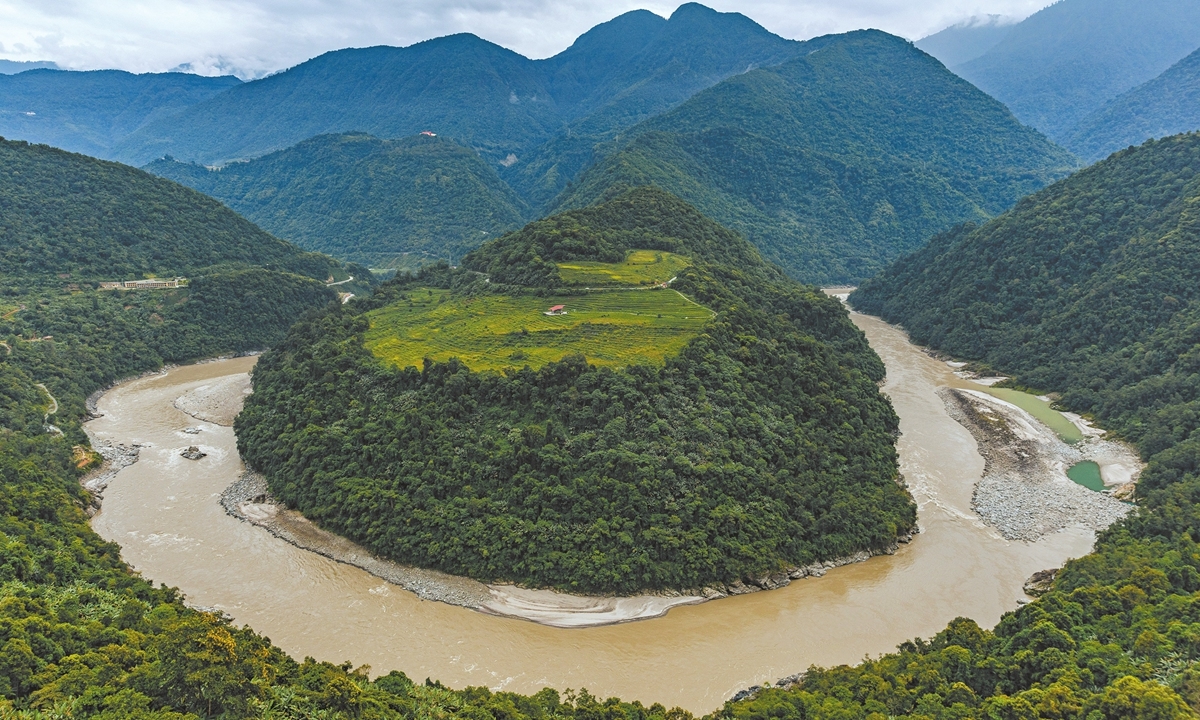
The Yarlung Zangbo River forms a dramatic bend at Guoguotang, one of its most iconic sights in Medog.

Children play football at Medog Elementary School in October 2025.
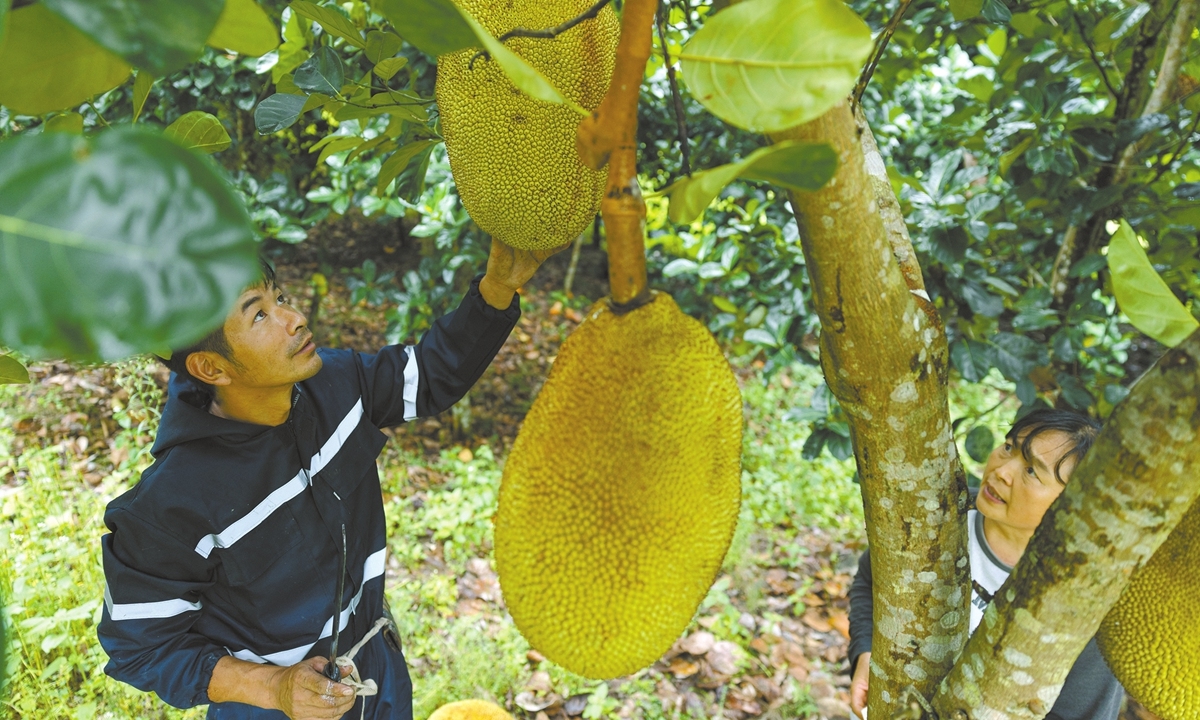
Two residents harvest jackfruit in Medog, where farmers have increasingly introduced new cash crops in recent years in October 2025.

Shops and homes line a street in Medog county center in October 2025.

A tourist photographs the towering Bhutan pine tree regarded as sacred by locals in Geling village in Beibeng township, Medog in October 2025.