
Ji Xue (second from left), from a family who relocated from their remote home in the mountains to a modern community as part of the poverty alleviation efforts five years ago, walks with her family in Anshun, Guizhou province, in December. YANG WENBIN/XINHUA
At a small plantation on the northern edge of the Himalaya Mountains range in the Xizang autonomous region, lingzhi mushrooms are being cultivated to increase the local income.
A medicinal fungus, lingzhi, also known as reishi mushroom, is traditionally foraged from the wild.
In a row of dim, humid single-story outbuildings, lingzhi spores are carefully grown into seedlings to be planted in nearby greenhouses. Close by, freshly harvested lingzhi mushrooms are neatly arranged on shelves to be dried for market.
This process has become all too common at the Red Sun Family Farm in Manling in Xizang's Nyingchi city, where efforts to grow medicinal herbs and fungi are changing lives for the better.
Cheng Pan, a local Party official, said the farm has become a cornerstone of their agricultural landscape.
The farm, which yielded 15 metric tons of dried lingzhi last year, is supplying seedlings and technical support to about 400 lingzhi-growing families in Manling to increase output.
"The growth is exponential," he said, emphasizing that lingzhi cultivated in Manling boasts superior quality compared to counterparts grown in lower-altitude regions, making them highly sought-after in the market.
The fungi are believed to enhance the immune system, helping the body fight off infections and illnesses, and have been used in traditional Chinese medicine for thousands of years.
Lingzhi mushrooms are being mass-produced in greenhouses as part of a growing medicinal farming industry in Manling. Just a few kilometers from the farm, the local government has collaborated with pharmaceutical companies from wealthier regions to cultivate beimu, or Fritillaria cirrhosa bulbs, a herb related to lilies, traditionally used for cough relief.
In a nearby pine forest, workers are excavating pits to sow seedlings of huangjing, also known as King Solomon's seal, which produces a herb known for its anti-inflammatory, antioxidant and immune-modulating properties.
Cheng said mass-producing such herbs can actually relieve pressure on the natural environment.
"Based on our current estimates, if we want to meet the high demand by having people dig wild beimu in the mountains, it is highly probable that within just two to three years, this species will be driven to extinction," he said.
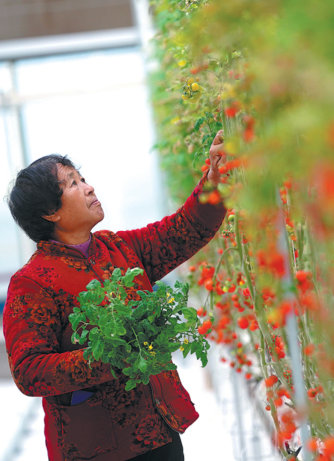
Xu Xiyun, a farmer at a village in Pingshan, Hebei province, tends to cherry tomato vines at a greenhouse in December. CHEN YEHUA/XINHUA
Red Sun Family Farm is owned by Nyima, a once-impoverished farmer who has not only transformed his own life but also uplifted many within his ethnic Tibetan community. He is considered a local "pioneer in prosperity".
The term is widely used by authorities to refer to individuals who lead by example in creating wealth or achieving financial success, often inspiring others to follow suit.
His journey to prosperity began 14 years ago with the cultivation of lingzhi.
Before that, there had been twists and turns in his business endeavors. In 2007, Nyima and his family of four were living in a modest 23-square-meter prefabricated home, struggling to make ends meet.
Seeking a change, he ventured into agricultural entrepreneurship. In 2008, Nyima took a loan of 150,000 yuan ($21,000) to establish a pig and chicken farm in his village. However, his business suffered due to a lack of knowledge about breeding techniques and an unfavorable market.
In 2010, authorities introduced policies aimed at developing Manling into a hub for medicinal herbs.
Sensing the business potential, Nyima shifted gears and founded a medicinal farm focusing on raising tianma, or Gastrodia elata, a herb related to orchids. The decision proved a big success, as he started earning a profit in the very first year.
Aided by the local government, Nyima in 2012 renamed the company Red Sun Family Farm, expanded its range of medicinal plants, and the business took off.
With a better financial standing, he thought about helping others. In 2016, at the height of China's fight against absolute poverty, he gave lingzhi seedlings to impoverished farmers to grow and offered to buy the harvests.
In 2021, Nyima was honored with a national award at the Great Hall of the People in Beijing for his contribution to poverty alleviation.
"We have established a sales network on the popular messaging app WeChat so that our herbs and fungi can be sold farther afield," he said.


