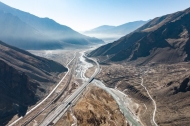
“Living here, I can personally feel the good ecological environment on both sides of the Lhasa River,” says Phuntsok, a deputy to the National People’s Congress, who chooses to live on the Xianzu Island in Lhasa City after retiring from Nagri Prefecture.
Nagri is Phuntsok’s hometown. He was born there and has been working there. During the years, he has witnessed the changes brought about by ecological protection. “In these years, the pastures in my hometown have been recuperated thanks to the returning grazing to grassland and returning farmland to grassland policy. When there is sufficient rain, the pastures are lush. Many wild animals that were rare in the past, such as wild donkeys and wild horses, are now in herds, running by road sides.” Phuntsok says that such a scene is a vivid manifestation of the ecological environment being well protected.
“Lhasa has always insisted on taking ecological environmental protection as the greatest potential and the strictest responsibility for sustainable development. Focusing on sustainable development and the future of the Chinese nation, we are devoted to protecting the green mountains, green waters and the glacier.” Guoguo, a deputy to the National People’s Congress and mayor of Lhasa says.
In fact, the act and concept of “protecting the ecological environment like protecting our eyes and treating the ecological environment as life” has long been conscious in Tibet.
“The green achievements accumulated by the people of Luntse from generation to generation are now becoming the spiritual and material wealth of local people. The amount of precipitation has increased; the number of days with sand and dust has decreased; the amount of fertile fields has increased; and the saline-alkali land has decreased,” said Konchog Chozin, a member of the National Committee of CPPCC, and deputy head of Luntse County, Lhoka. She says that in recent years, the county has established 8 autonomous-level ecological towns and 76 autonomous-level ecological villages. Ecological environment protection has greatly benefitted people’s lives, for example, the development of eco-tourism areas in Zhari and Yumai Townships has broadened the channels for farmers and herdsmen to increase income and stimulated the vitality of rural tourism. At the same time, the green industry marked by Luntse “Black Highland Barley” has flourished. There are 9 black highland barley processing enterprises in the county, with an annual processing capacity of more than 1.25 million kilograms.
Ao Liuquan, a member of the National Committee of CPPCC and Party secretary of Nyingchi City, says that in recent years, Nyingchi has made every effort to promote ecological protection. Through adhering to the systematic management of mountains, rivers, forests, fields, lakes, grass, sand and ice, Nyingchi has fought for blue sky, clear water and pure land, and the proportion of air quality compliance days has remained at 100%, ranking first among 337 cities above the prefecture level in the country for 4 consecutive years. To correctly handle the relationship between “greening up” and “getting rich”, in 2021, the municipal finance allocated 270 million yuan for the management and protection of ecological public welfare forests. This alone has increased the per capita annual income of farmers and herdsmen in Nyingchi by more than 1,850 yuan.