West China Hospital of Sichuan University is no stranger to Tibetans. You can see monks clad in the yellow top and red bottoms and grannies with strong-colored, traditional garments everywhere. Therefore, I was not surprised when two Tibetan boys were in my baby girl’s ward. I was taken off guard, however, when knowing both of them came here all the way from Qinghai, a northwest province of China, with its capital city Xi’ning much closer.
The reasons are easy to find out: a good reputation and favorable policies. Ranked #10 globally and #1 in China, in Nature Index’s research outputs ranking among healthcare institutes in 1 Dec. 2021-30 Nov. 2022, the hospital provides fast inpatient registration and free translation services for Tibetan patients, and train Tibetan medical students. No wonder Tibetans go directly here when the local hospitals cannot solve the medical problems.
When I carried my baby girl to the ward, the two-month-old Kunga Dawa was sleeping sound in his bed, his farther Phurbu Gyaltshan lying beside him and humming him a lullaby, and his monk uncle Tseten Namgyal sitting in a chair chanting scriptures for him. I tried to strike up a conversation and ask Gyaltshan what’s wrong with the baby boy, but he failed to respond. Obviously, communication was a problem and we needed a translator. Am I not a translator? My brilliant brain told me so and urged me to speak Tibetan. “Tashi delek.” I blurted out but stopped, not a clue of what to say next. Suddenly, I realized I am an English-Chinese translator. The interfaces that connected the language pairs went wrong.
I tried to fix the problem by asking him slowly with easy words in Mandarin just like how I would say to my baby girl. This time, he seemed to understand my question and replied in Mandarin, “Tummy. Poo.” Succinct, yet efficient enough to let me know the problem. Later, a nurse told me Kunga was suffering from megacolon of newborn. For almost four decades, it’s my first time to hear about this word, and I was impressed that two simple words roughly explained a medical term.
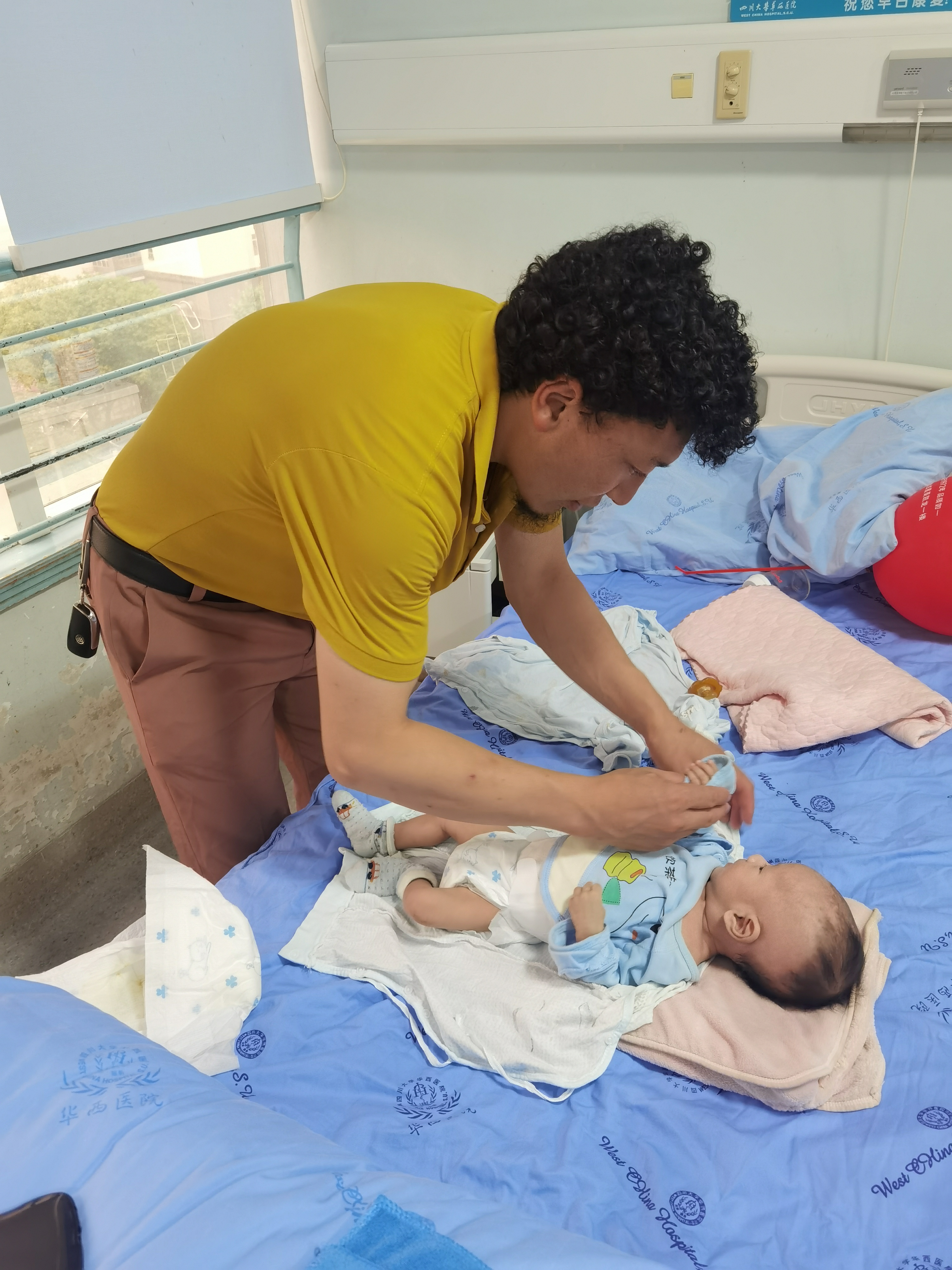
Phurbu is changing Kunga
The language barrier is far from the most difficult. At least, Tibetan nurses and medical students can help. I can’t believe a father can take care of a baby alone, but Phurbu did it.
Phurbu’s wife stayed back home digging up cordyceps sinensis which is a common activity in all Tibetan-inhabited regions in summer. Tseten Namgyal, Phurbu’s brother-in-law, came to Chengdu with him but went back to hotel after dinner every evening, leaving Phurbu holding the ground himself. He proved to be a committed soldier, and finished the mission impossible that no man-else can do.
Kunga would only cry when necessary. Probably because he had cried too much after the first surgery and was tired of it, or the soothing dharma that his father played him was a relief. But his hoarse voice was powerful enough to make his father take actions immediately.
As a father of 6 children, he showed wild yet honed nursing skills. Phurbu would check the time first. A baby at this age should be fed every three hours. If time had come, he would leave Kunga in bed and make a bottle of Alfaré HMO (a special formula for babies with CMPA-rated malabsorption). Sometimes Kunga was at the edge of the bed, and I would put a pillow beside to prevent him from rolling over down to the ground. If Kunga cried not in a milk time, Phurbu would reach out his hands and hold the baby up in the arms, singing him a folk song.

Kunga lying on the lap of the sleeping Phurbu
Time was particularly tough during the night when a baby needed a quiet environment. When lights were out around 21:00, the rumbustious room would not die down before 23:00. Aunties answered phone calls in the evening, talking about important gossips. Some watched the European Cup and clearly forgot about putting on earphones. An 11-year-old game-addicted boy was extremely brave. He couldn’t move as he wanted because he was being put on a drip from dawn to dusk, but I heard him firing an AK47 in the virtual world at 01:30 one night.
None of these were problems, Phurbu played Kunga scripture chanting with his cellphone. Lying on the 6-yuan-per-night convertible canvas bed borrowed from the hospital, I found the dharma very calming—a feeling you would find in a sanctuary. I fell into sleep without knowing it and was startled by a cry. When I sat up, Phurbu was preparing formula milk. He took my advice and enclosed the crying baby with the comforter. I smiled at Kunga. His big and watery eyes blinked at me during the interval of his cries. I lied down when I saw the baby sucking the bottled milk satisfactorily and hit the sack. Asleep or not, I was not sure, but pretty sure there’s a big bang. It was so loud that I couldn’t help but sit up again to see what’s happening. Phurbu emerged from under the bed, ruffling his black, curly hair that I envied so much. “Are you all right?” I asked worriedly. “Fine.” He answered curtly as he always did. It could be carelessness or sleeplessness. Either one was torturing the man, but he defied it with a father’s love. I fell asleep again without knowing what happened next.
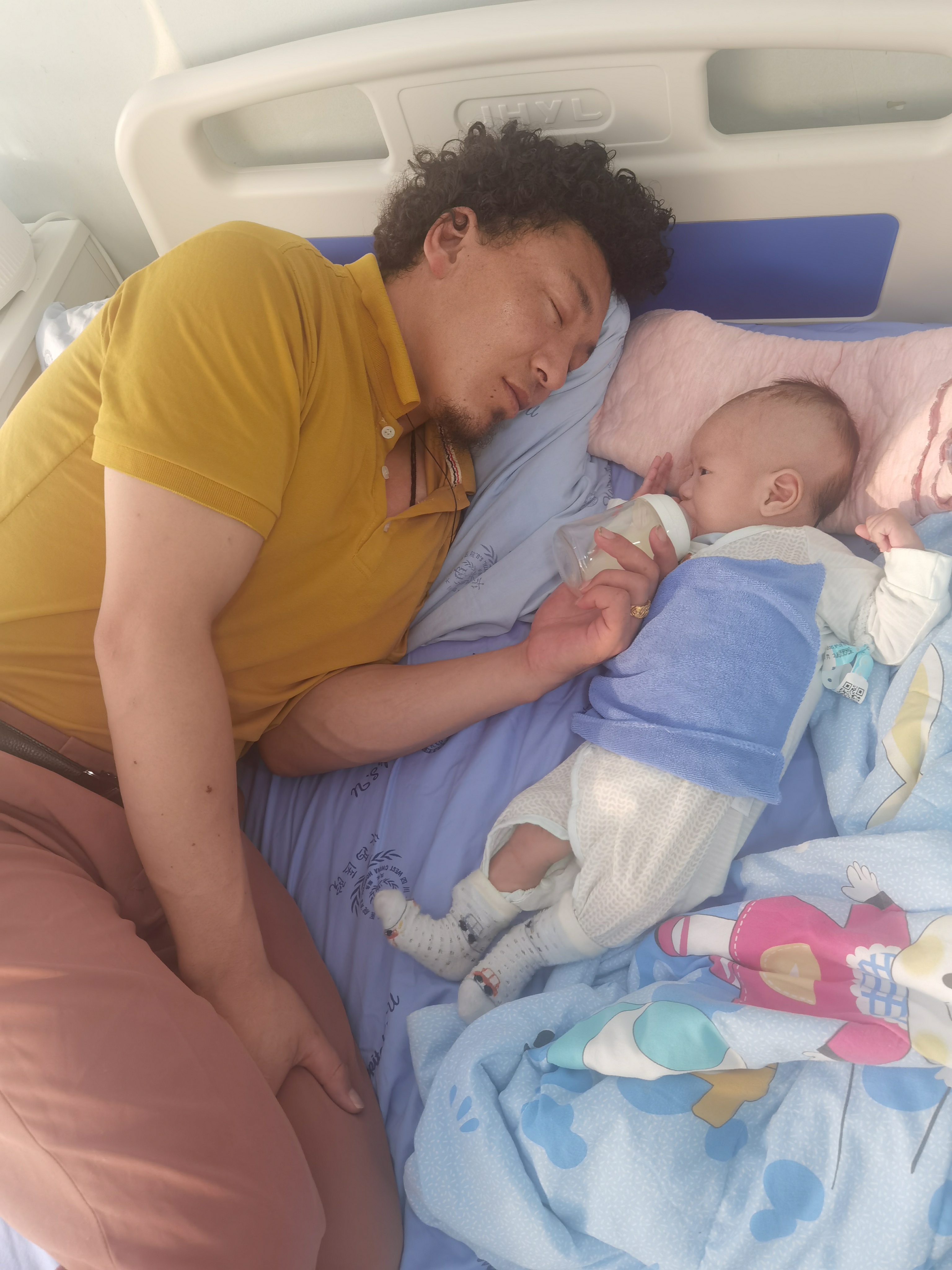
Phurbu fell asleep while feeding Kunga
Phurbu answered a call in an afternoon. Not fully understand what the man on the other side of the phone said, he asked me what’s going on. I set the phone into the loud speaker mode and explained that he would receive a 20,000 yuan subsidy for Kunga’s surgeries from the government. I felt happy because he could spend more time worrying about his baby boy instead of the medical expenses.
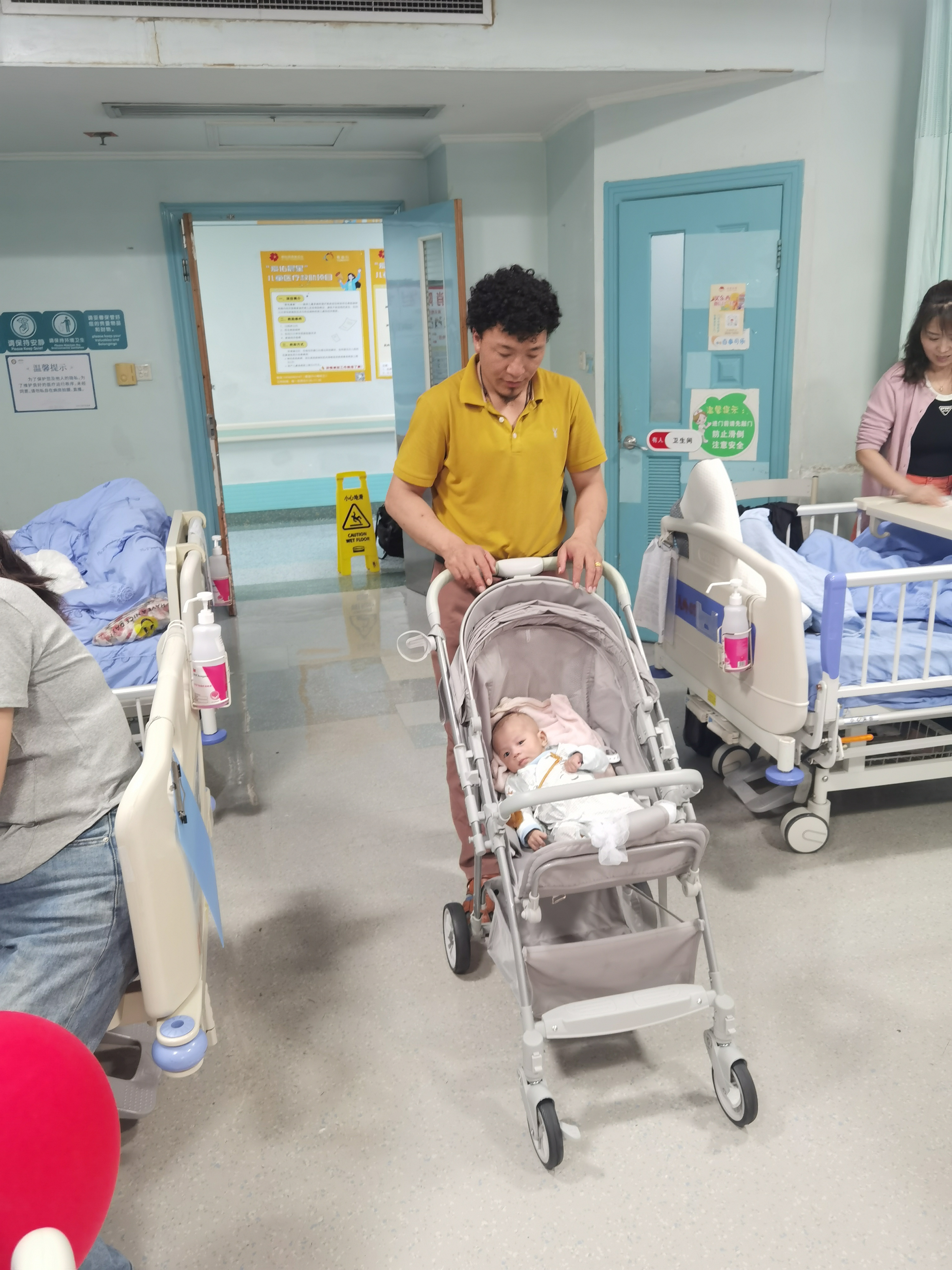
Kunga strolling in a baby carriage bought in Chengdu with the help of a ward-mate
My baby girl was discharged from the hospital on Sunday. And Kunga will have his second surgery on Monday. Buddha bless him, for the sake of love.
Graduated with an MA from University of Surrey in October, 2014, Zhang Lindong is a translator, interpreter and editor. Committed to preserving the traditional Tibetan culture, he has been working in the sector for almost ten years.


